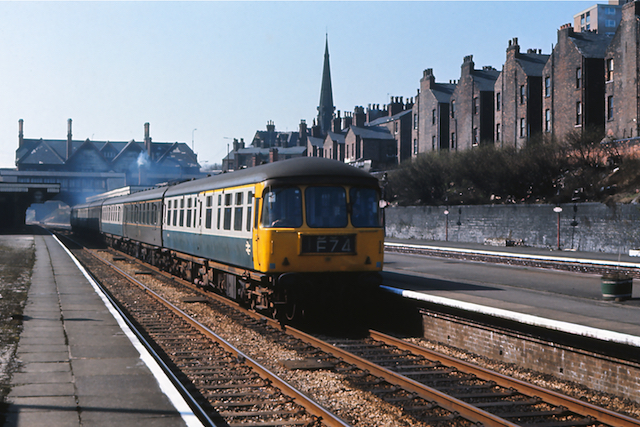
Eccles Station Heritage - Some Memories
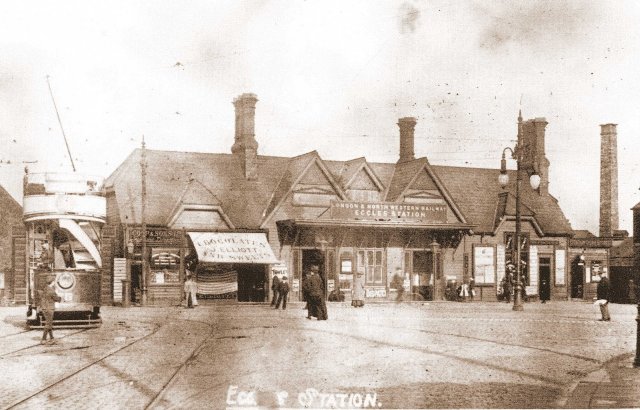
If you have memories or photographs of Eccles station that you would be willing to share with us, FRECCLES would appreciate your contributions. Please email to anntaverneruk@aol.com or come in to Eccles art gallery in Southway between 11am and 1pm on Saturdays and talk to one of our members.
The 1941 Accident
A genuine local tragedy...
At 8.15 am on 30th December 1941 a train carrying workers from Rochdale to Pennington crashed into another train carrying workers into Manchester. 23 passengers died and 56 were seriously injured. Being wartime, this accident never had much publicity outside the Manchester area, but the retaining wall of the station carried the marks of the trains crashing into it until it was demolished to build the M602 motorway in the early 1970s. The line was noted for fog. There had been several accidents before 1871, when railway companies were first forced by law to investigate accidents.
In 1877, the first such recorded accident at Eccles junction noted that a driver had gone through a red signal in fog and hit the Liverpool/Manchester express. No one was killed, and the driver was fined 1s, as he had been for previous similar accidents he had caused. The investigation took it for granted that train drivers could well have been drinking before they went on shift..... In 1941, thick fog, smoke from factories and wartime blackout would have made it nearly impossible to see at 8.15 on a December morning...
Signalmen were sent to sit at remote signals to show lamps and set off detonators when a train passed in such conditions. The hours on their rotas to do this job could be very casual. One of the signalmen in this incident was told he could go home at 7am, but the next man was only to come on at 8.30am. To make matters worse, 3 of that morning's relief signalmen had similar names, and the signalman at Eccles signal box confused 2 of them, thinking that all the signals were manned - they were not.
The enquiry into the accident held the Eccles signalman to blame for not realising that a signal was unmanned and not therefore stopping the Pennington train. But they also blamed that train's driver for going too fast and ignoring what signals were given... Being wartime, a large number of the casualties were young women or men too young or old for military service.
The rescue efforts were probably helped by wartime emergency services being on alert - but it still took 5 hours to get all the dead and injured out, and 2 days until the line was open again... Many of the people injured came from across what is now Greater Manchester - from Leigh, Tyldsley, Chadderton and Oldham as well as from Eccles and Monton.
Surgeons and nurses who treated the injured came from Eccles and Patricroft hospital which was closest to the scene, as well as from Hope and Ladywell hospitals. This crash was a genuine accident - caused by fog,wartime staff shortages and genuine human error. Better signalling and more formal work rotas were the recommendations of the enquiry into the crash, but it took several years before these were put into place.
By 1984 when Eccles last train crash occurred, signaling had improved and the 'smogs' of earlier years were a thing of the past. This accident, when a passenger train into Manchester ran into the back of an oil train on a clear day does not have any explanation for why the driver missed a red signal...the only conclusion the enquiry came to was that he was disorientated from switching from night to day shifts - sadly the driver was one of the 3 fatalities of the accident. Afterwards, the warehousing alongside the line was painted white, as it is possible that the red signal could not be clearly seen against the buildings.
The station in the 1950s - Childhood memories, work and courtships....
The station in the 1950s was at the centre of life in the town
Life for Eccles children
- "there was a pet shop on the corner. it had a parrot outside and the kids used to tease it..."
- "the school crossing to Clarendon Road was on the corner by the station....a policeman used to see you across..."
- "I remember my Dad taking us to the shoe shop just opposite....."
- "I remember going to Blackpool on the steam trains... we used to crowd up to the windows to pretend that the compartment was full so we could have it to ourselves..."
- " the sounds, the smells...."
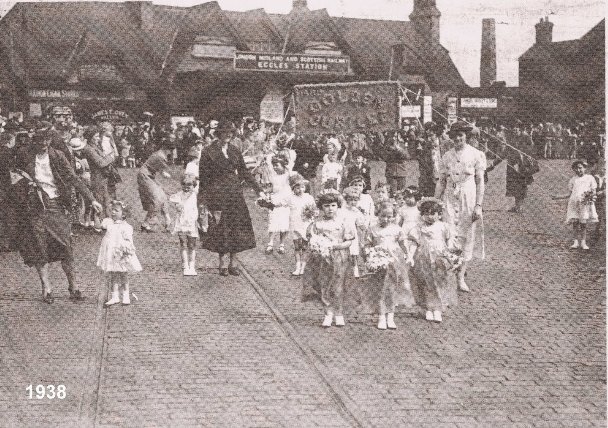
- "The Whit walks always used to go past the station..."
- "there was an electrical shop up there. It used to take back radio batteries - the sign said 'BRING THEM BACK ALIVE'. There was another sign threatening 'BURGLARS WILL BE ELECTROCUTED'"
- "we thought that if you dropped a stone into the funnel of a train as it went under the bridge that the train would explode. We all dared each other to do it...not really believing it was true, but worried in case it was. You got filthy from leaning over into the steam as it came out of the trains...."
Work
- "I worked in the booking office for about 6 months when I left school - happy times"
- "One of my friends worked in the newsagents that was in the station. She loved it..."
- "I had the estate agents in the station building. When it burned down it did me a favour really as I wanted to close the business...."
- "there was a nice sweet shop - I can't remember if it was part of the station or just next door...."
- "the station must have had about a dozen staff: in the booking office, porters and so on. there were usually about 6 staff on at any one time, and they were all very friendly..."
- "the porters used to look after the station gardens. Well-off people from Worsley used to give plants from their gardens when the trains from Bolton stopped at Eccles Station...."
Courtship and social life
- "when we were courting we used to look in all the shop windows on Church Street down from the station. Everybody did it. We didn't have the money to get a bus anywhere else..."
- "there were some lovely shops. I liked looking in Fryers the furniture shop and there was a lovely jewellers..."
- "we used to go to dances. At Christmas everyone used to give you a kiss in the street to wish you a Merry christmas..."
Whit Walks in 1938